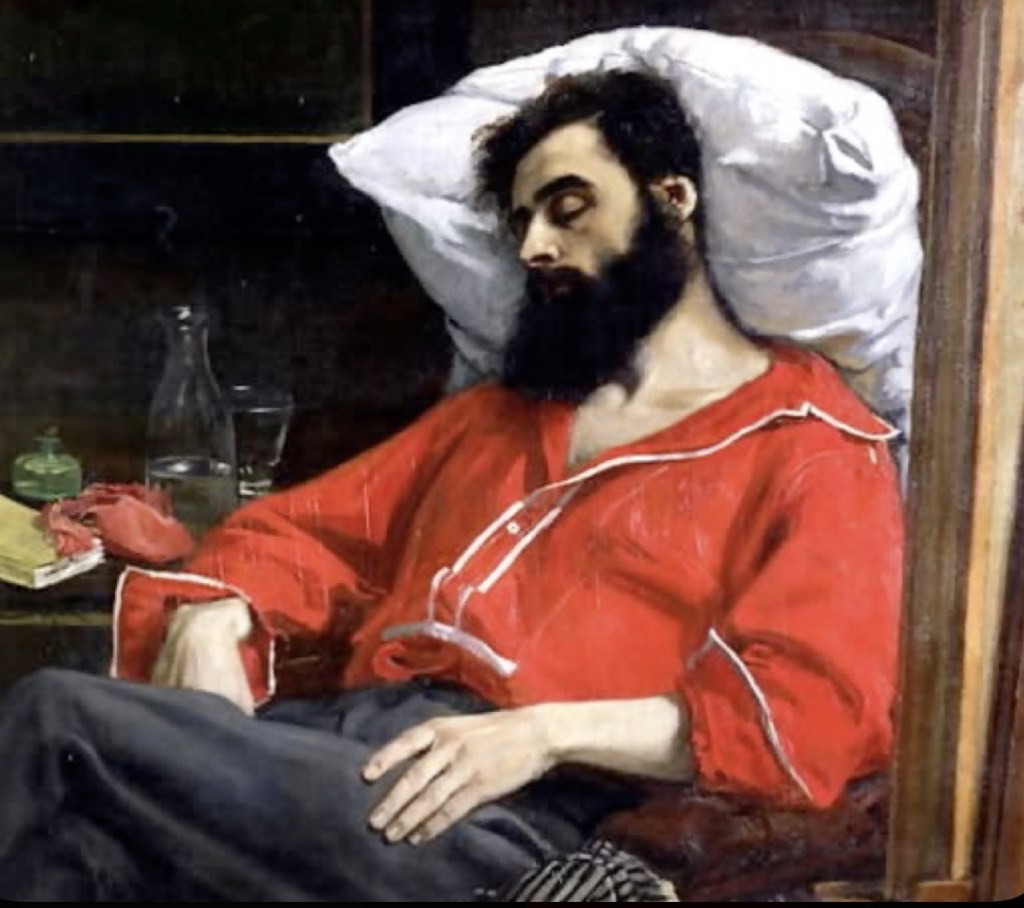
I recently finished The Death of Ivan Ilyich, and I didn’t expect such a short book to leave such a lasting impact.
On the surface, it’s simple: a successful man falls ill and slowly dies. But beneath that, it’s something far more unsettling. It’s a mirror.
Ivan Ilyich is everything society tells us to become. He builds a respectable career, becomes a high-ranking legal figure, marries appropriately, and lives a life that looks “right” from the outside. Yet, as the story unfolds, you begin to see the cracks.
He spends less and less time at home. His marriage becomes a source of irritation rather than comfort. His real moments of enjoyment shrink to small, controlled escapes like playing bridge. Life becomes structured, efficient, and outwardly impressive — but emotionally hollow.
And then comes the illness.
What makes Tolstoy brilliant is that he never clearly defines it. The disease itself almost doesn’t matter. What matters is what it does to Ivan: it strips away his illusions.
For the first time, he is forced to confront a terrifying question:
“What if my entire life was wrong?”
At the beginning of the story, Ivan is not particularly likable. In fact, to some around him, he comes across as cold, self-centered, even somewhat despicable. His relationships are shallow, his priorities conventional, and his life feels more performed than lived.
But something changes.
As his condition worsens, the roles fall away. The status, the pride, the social mask — all of it becomes irrelevant. What remains is not a powerful man, but a frightened human being.
And this is where the emotional shift happens.
You stop judging him. You start feeling sorry for him.
Because his tragedy isn’t dramatic or unique. It’s ordinary. It’s the slow realization that he spent years optimizing for the wrong things — for prestige, status, and external approval — while neglecting what actually makes life meaningful.
One of the most powerful contrasts in the book is his relationship with Gerasim, a simple servant. While everyone else avoids the truth of Ivan’s condition, Gerasim is the only one who is honest, present, and compassionate.
Ivan finds comfort not in his peers, not in his wife, not in his achievements — but in someone who simply sits with him and acknowledges reality without fear.
That detail stays with you.
At the end of life, what matters isn’t status. It isn’t titles. It isn’t what others thought of you.
It’s whether you lived truthfully, and whether anyone was truly there with you.
This book made me reflect on something uncomfortable but important: how easy it is to drift into a life that looks right but feels wrong. Not through big mistakes, but through small, repeated compromises over time.
That’s what makes this story so powerful.
It’s not just about death. It’s about how we live.
And in a strange way, that’s why I found it so engaging. It’s short, direct, and deeply thought-provoking. It doesn’t try to impress you — it just quietly forces you to think.
There’s a certain smug confidence that comes with eating vegetables before a workout. You feel like a superior human being. Disciplined. Clean. Possibly glowing. The kind of man who says things like “I fuel my body properly” while judging others for their protein shakes.
That was me.
And then… the broccoli happened.
The Setup: A Heroic Mistake
I decided, in a moment of nutritional righteousness, to have a pre-workout meal consisting of mixed vegetables and broth. Broccoli, cauliflower, the whole fibre-rich orchestra.
In theory? Brilliant. In reality? I had just loaded my digestive system with a gas-producing biochemical experiment right before asking my body to sprint, lift, and survive.
What Actually Happened (A Scientific Disaster)
Vegetables like broccoli and cauliflower are rich in raffinose, a carbohydrate your body can’t fully digest.
So what happens? Your gut bacteria take over.
And they don’t quietly “process” it. They throw a full-blown fermentation party.
Now combine that with:
Increased blood flow to muscles (not your gut)
Physical movement (a.k.a. shaking the bottle)
Heavy breathing and pressure
You don’t get energy. You get… internal chaos.
The Symptoms (Also Known as Humiliation)
Zero stamina
Stomach discomfort
The overwhelming urge to pass gas like a broken exhaust pipe
A general feeling that your body is actively protesting your life choices
At one point, I wasn’t sure if I was training… or negotiating with my intestines.
The Reality: Pre-Workout Is Not a Moral Competition
Here’s the uncomfortable truth: Not all “healthy” foods are good pre-workout foods.
Vegetables are fantastic… Just not 30–60 minutes before you try to deadlift your dignity.
Pre-workout nutrition is about:
Quick digestion
Stable energy
Minimal digestive drama
Vegetables fail spectacularly at all three in that specific window.
The Correct Approach (a.k.a. Grow Up)
Instead of trying to be a nutritional philosopher, stick to things your body actually understands under pressure:
Banana + yogurt → fast carbs + light protein
Simple pre-workout shake → controlled, predictable energy
Toast with honey or peanut butter → easy fuel
These don’t ferment into a biological weapon mid-set.
The Psychological Lesson (because your brain matters too)
There’s a concept in psychology called “moral licensing”. You do something “good” (eat vegetables), so you expect a positive outcome everywhere else.
Your body doesn’t care.
It runs on biology, not virtue signaling.
Final Thought
Vegetables are not the enemy. Timing is.
Eat them daily. Build health. Feed your gut. Just don’t throw them into your system right before a workout and expect heroics.
Because nothing kills momentum like realizing halfway through a set that your biggest opponent… is broccoli.
Eat smart. Train hard. And for the love of dignity, don’t turn your stomach into a fermentation lab before leg day.
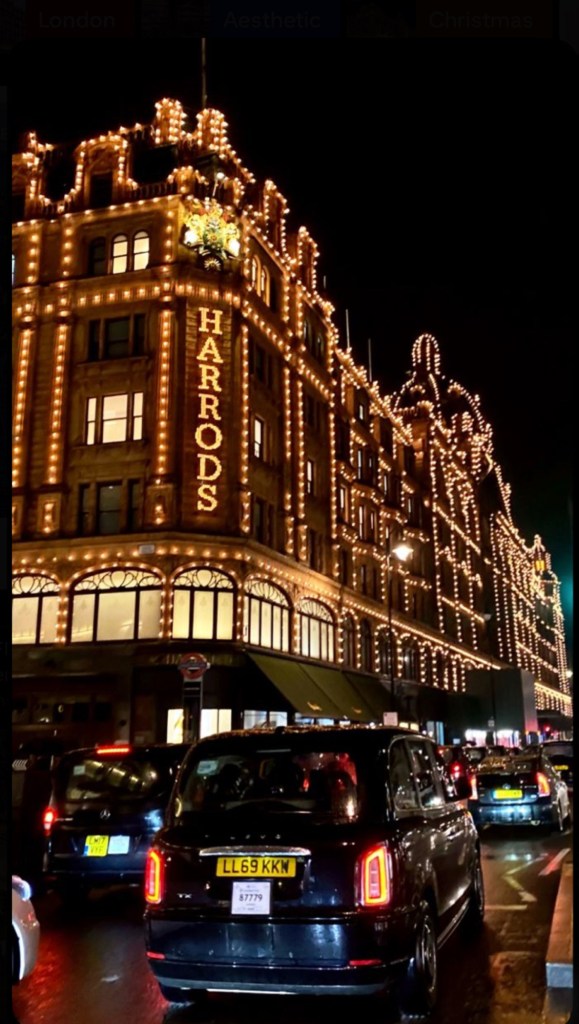
Walk into Harrods and it feels like a temple to wealth. Marble under your feet, soft lighting everywhere, and prices that make you reconsider your life decisions. But beneath all that polish is a story that’s far less pristine — and far more human.
Harrods didn’t begin as a global icon. In the 1800s, it was just a modest grocery shop selling tea, bread, and basics. Ordinary. Almost forgettable. Then, in 1883, it burned to the ground. Completely destroyed.
Most businesses would have disappeared.
Harrods didn’t.
It rebuilt — bigger, grander, more ambitious. Almost as if the fire gave it permission to become something else. And that theme of reinvention… never really left.
Fast forward to 1997.
After the deaths of Princess Diana and Dodi Fayed, Harrods became something no luxury store had ever dared to be: a place of public mourning. Its owner at the time, Mohamed Al-Fayed, transformed part of the store into a memorial. Not a subtle tribute tucked away in a corner — but a full, unapologetic shrine.
A statue. A glass case. Personal artifacts. A love story frozen in time.
And the strange part?
People didn’t ignore it.
Shoppers would walk through the store, moving from designer handbags to a space that felt… heavy. Emotional. Some stood quietly. Some stared. Some felt uncomfortable. Others felt something deeper — a kind of unexpected respect. It blurred the line between commerce and grief in a way that felt almost surreal.
Imagine buying a £2,000 coat… then turning a corner and being confronted with loss.
It shouldn’t have worked.
And yet, Harrods continued to thrive. If anything, its uniqueness — even its strangeness — became part of its identity. It wasn’t just a store anymore. It was an experience. A story. A place people talked about.
Then in 2010, everything changed.
Harrods was sold to the Qatar Investment Authority — the sovereign wealth fund of Qatar. New ownership. New direction. And with it, a quiet but decisive shift.
The memorial was removed.
No drama. No announcement that echoed through the halls. Just… gone. As if the building had decided to move forward, leaving that chapter behind.
And what replaced it?
Refinement. Expansion. Even more luxury. Harrods doubled down on what it does best — becoming not just a department store, but a global symbol of ultra-premium retail. Cleaner. Sharper. More focused.
Did it affect business?
If anything, Harrods became even more commercially powerful. The emotional layer was stripped away, but the brand became clearer. More international. More aligned with the expectations of global luxury shoppers.
Less complicated.
But perhaps… also less human.
Because here’s the truth most people miss:
Harrods has always been more than what it sells.
A shop that burned down and came back stronger. A place that once sold everything from groceries to exotic animals — including lions, for those wealthy enough to consider it. A building that, for a time, carried grief openly in its corridors.
Most luxury spaces try to feel perfect.
Harrods never really was.
And maybe that’s why it still fascinates.
Because behind the gold, the glass, and the quiet confidence… there’s a history that refuses to be completely polished away.
Humans are incredibly sensitive to social norms. Experiments show that people will adopt behaviors they once thought immoral if enough people around them normalize it.
Open a flight-tracking app like Flightradar24 and start exploring airports around the world.
At first glance, all runways look identical: long strips of asphalt stretching across flat land, with mysterious labels like 12L, 30R, or 09L.
To most people they all look the same.
But in reality, runway design reflects a fascinating mix of aircraft physics, weather conditions, airport traffic, and geography. What seems like a simple strip of pavement is actually one of the most carefully engineered parts of aviation.
Let’s start with the basics.
The Secret Behind Runway Numbers
Every runway is named based on its magnetic compass direction.
For example:
Runway 12 means the aircraft is heading roughly 120° The opposite direction becomes 30 (300°)
Since airplanes can take off and land in both directions, the same runway always has two numbers.
When airports have multiple parallel runways, letters are added:
L = Left R = Right C = Center
So a runway labeled 12L / 30R simply means it’s the left runway when approaching from one direction, and the right runway when approaching from the other.
This system is standardized worldwide by the International Civil Aviation Organization.
Comparing Some Major International Airports
Let’s look at several global hubs and their runway sizes.
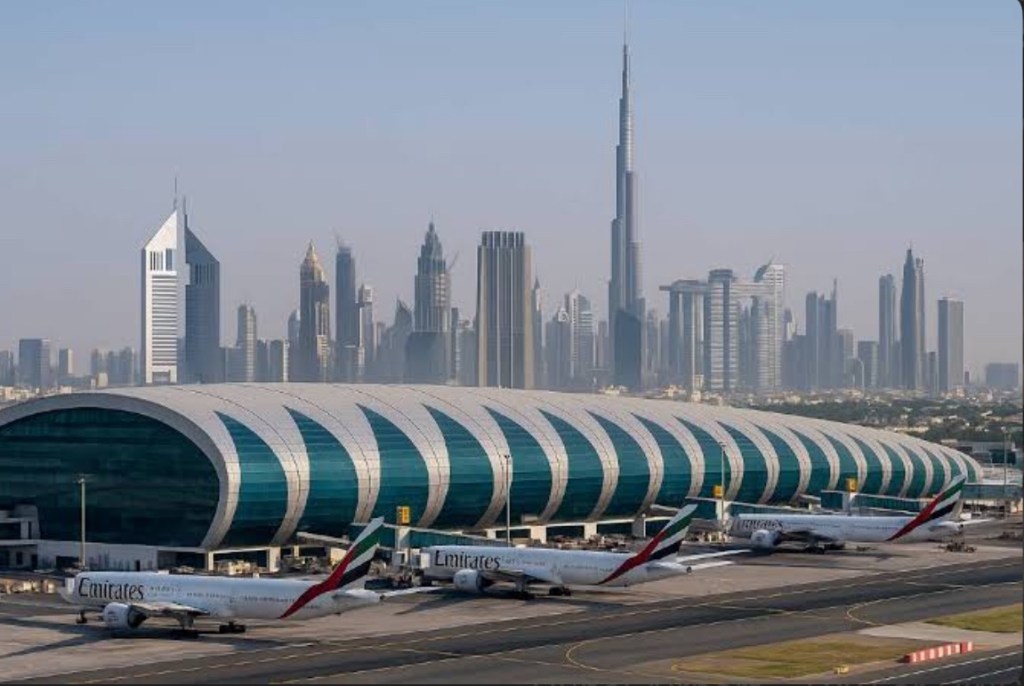
Dubai International Airport
Dubai operates with two parallel runways.
Runway lengths:
4,351 m (14,275 ft) 4,447 m (14,590 ft)
Dubai built very long runways to support heavy long-haul aircraft such as the Airbus A380.
Hot weather reduces engine performance, so aircraft require longer takeoff distances.
Abu Dhabi Zayed International Airport
Abu Dhabi also operates two runways.
Runway lengths:
4,100 m 4,106 m
Slightly shorter than Dubai’s, but still more than capable of handling the largest commercial aircraft.
Hamad International Airport
Doha features one of the longest runways in the world.
Runway lengths:
4,850 m (15,912 ft) 4,250 m
Qatar had plenty of space when designing the airport, so engineers built extremely long runways capable of handling fully loaded long-haul aircraft even in extreme heat.
London Heathrow Airport
Heathrow is one of the busiest airports in the world, yet it only has two runways.
Runway lengths:
3,901 m 3,658 m
These runways are shorter because Heathrow was built in the 1940s, long before modern widebody aircraft existed.
Urban development around the airport now makes expansion extremely difficult.
Why Runway Length Matters
Large aircraft such as the Boeing 777-300ER can weigh over 350 tons at takeoff.
Heavier aircraft require:
longer acceleration distance more lift more runway
Hot weather, high altitude, and heavy payloads all increase the runway length required for safe takeoff.
That’s why airports in hot climates tend to build longer runways.
How Many Runways Do Airports Have?
The number of runways at an airport usually reflects traffic volume.
Airports With 1 Runway
Smaller airports often only need one runway.
Examples:
London City Airport Ibiza Airport Mykonos Airport Paro International Airport Skiathos Airport
These airports handle relatively modest traffic levels.
Airports With 2 Runways
Two runways are the most common configuration for major airports.
Examples:
Dubai International Airport Hamad International Airport Abu Dhabi Zayed International Airport London Heathrow Airport Hong Kong International Airport
Two parallel runways allow aircraft to take off and land simultaneously, dramatically increasing airport capacity.
Airports With 3 Runways
Some large international airports operate three runways to handle heavy traffic.
Examples:
Singapore Changi Airport Tokyo Haneda Airport Beijing Capital International Airport Istanbul Airport Bangkok Suvarnabhumi Airport
These airports support extremely high traffic volumes.
Airports With 4 Runways
The world’s biggest aviation hubs operate four runways or more.
Examples:
Frankfurt Airport Paris Charles de Gaulle Airport Los Angeles International Airport Shanghai Pudong International Airport Dallas Fort Worth International Airport
These airports can handle over 100 aircraft movements per hour.
The Hidden Complexity of Runways
To passengers, runways may look identical.
But to pilots, airport planners, and air traffic controllers they represent a delicate balance of:



 Simply K