The alarm goes off, the phone gets grabbed, the curtains stay shut. Most of us treat morning light as optional. But that’s not the whole story.. your body was doing something clever with that light before you decided to ignore it.
Andrew Huberman, a neuroscientist at Stanford University, makes a simple case: cortisol isn’t the villain everyone assumes. It’s a rhythm. Get it right in the morning and it fades quietly by night. Get it wrong, and it shows up uninvited at 2am, like a party guest who’s misread the invitation.
The mechanism is straightforward. Sunlight hitting the eyes, no sunglasses, no cheating through a window, reports straight to the brain’s master clock.
Within the first hour of waking, this triggers a healthy cortisol surge that sharpens mood and focus, then sets up a lower trough later that helps you sleep. Ten minutes does it, longer if the sky’s doing its usual grey impression.
Why delay the coffee?
Because caffeine and cortisol are both stimulants, and stacking them is like double-booking your own energy.. you pay for it by mid-afternoon. Cold showers work differently: mostly adrenaline, giving you the jolt without piling more cortisol onto an already-firing system.
The evening is where people undo the morning’s work in about four minutes of doomscrolling. Bright light after dark tells the brain it’s still daytime, delaying the cortisol decline and any hope of drifting off unaided. Dim the lights. Skip the late workout.
Nobody’s asking for monastic restraint, just enough to stop sabotaging yourself, which, admittedly, isn’t Britain’s strong suit either.
The twist: none of this suppresses cortisol. It just lets the hormone do its one job properly in the morning, so it isn’t forced into an unscheduled encore at midnight.
Which is, rather elegantly, an argument for simply going outside, something your ancestors managed without a podcast to tell them.
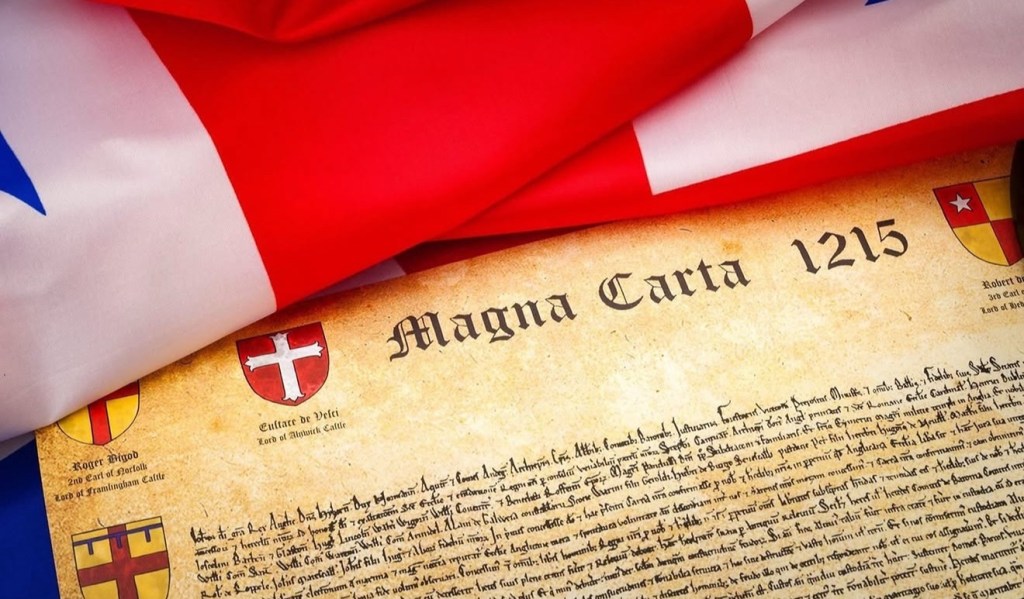
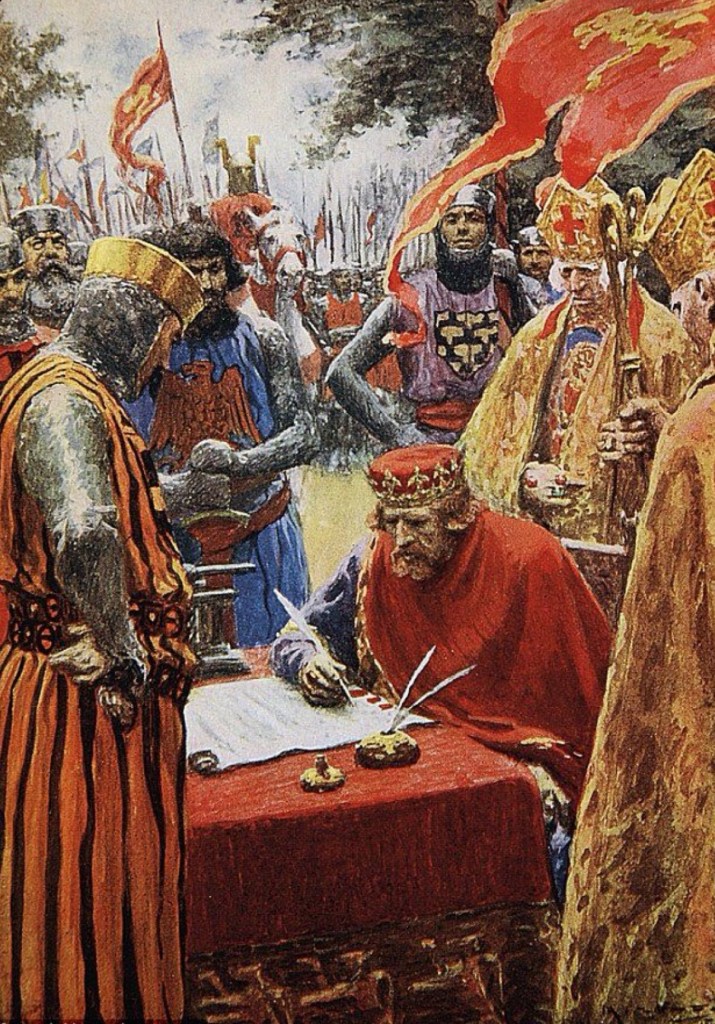
The year is 1215. The king is John of England, 48 years old and thoroughly out of patience with everyone. A man so disliked that history remembers him mostly by his nicknames. Honestly, the whole saga reads like a few useless line managers I’ve ever had, rolled into one crown: overpromised, underdelivered, blamed everyone else, somehow still employed. Picture the poor sod standing in a soggy meadow by the Thames, barons in armour all around, about to press his seal onto a document he’d rather not sign at all. That’s Magna Carta being born. But that’s not the whole story.
John had earned those nicknames the hard way: “Lackland,” for losing his family’s territory in France, and “Softsword,” for losing it badly. After a humiliating defeat at Bouvines in 1214, he came home broke and unpopular, having taxed his barons half to death to fund the whole disaster. They’d had enough. In May 1215 they seized London, and suddenly John had no army left to argue with. Negotiation, it turns out, is what happens when your options run out.
At Runnymede, the barons handed him a wish list, later called the Articles of the Barons and Archbishop Stephen Langton hammered it into a formal charter.
“Magna Carta” is Latin for “Great Charter,” and underneath the grand name it was really just a peace deal: the king agreed he wasn’t above the law, that free men couldn’t be jailed without a fair trial, that the church kept its rights and that taxes couldn’t be dreamed up on royal whim. On 15 June 1215, John sealed it. Not signed. Sealed. Medieval kings didn’t do autographs; they let a lump of wax do the talking. Very on-brand for a man already known for not following through.
So did it instantly usher in the age of liberty and justice for all?
Not remotely. Within ten weeks, Pope Innocent III annulled it, calling it “shameful, demeaning, illegal and unjust” which, translated from Latin, roughly means “absolutely not.” As if the memo wasn’t humiliating enough, he was dead within the year, at Newark, reportedly of dysentery, though rumours of monkish poisoning have always been the juicier story.
Here’s the twist, though. Magna Carta refused to stay dead. Henry III’s minority government reissued it, and it kept getting reissued for decades, quietly hardening into the idea that even a king answers to the law. Of its original 63 clauses, only three technically remain law in England today.
Four original 1215 copies survive: two at the British Library in London, one at Lincoln Cathedral, one at Salisbury Cathedral, still legible after eight centuries.
Was it a triumph of justice, or history’s most successful rebound relationship?
Either way, it stuck around longer than anyone at Runnymede expected, including, one suspects, Poor King John himself.
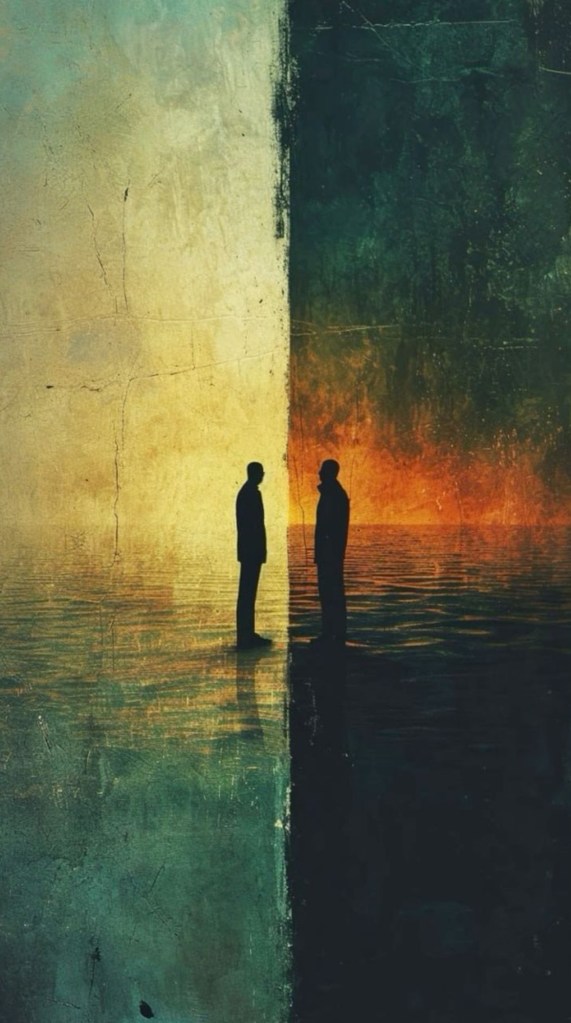
Here’s a theory, and it isn’t borrowed. Children who don’t merge into the community around them, the real one, the majority one, not just a tight little unit of parents & siblings and one loyal cousin, don’t just struggle. Evolutionarily speaking, they go extinct (not in the literal sense, more like abandoned by their own). Call it Coexist or Co-Extinct. Look at the data, and it stops sounding like a slogan and starts sounding like an overdue diagnosis.
Full disclosure on where this comes from: I didn’t read it in a journal. I lived it, for 43 years, as the unintended field experiment of two parents from completely different backgrounds and cultures who never quite agreed on which village I was supposed to belong to. Nobody handed me a manual. I had to reverse-engineer the theory the expensive way… trial, error, and a fair bit of unnecessary isolation along the route. Consider this article the refund.
Start with the obvious: no human was ever raised by two people alone. Anthropologist Sarah Hrdy calls us “cooperative breeders”, the only great ape whose infants are handed round a whole network of caregivers, related or not.
Take the Agta of the Philippines and the BaYaka of the Congo Basin (research them yourself!), two hunter-gatherer peoples anthropologists study precisely because they still live the way most of our ancestors did. A 2024 study of both groups found people beyond the parents, unrelated campmates and teenage neighbours included, doing a large share of the hands-on childcare. Chimps don’t get this deal. Lose the mother, lose the infant. Smart humans built spares.
Jordan Peterson made roughly the same case, minus the anthropology. His claim: it is the primary duty of parents to make their children socially desirable, and by his account the window for making a child acceptable to its peers closes around age four. Blunt, but it lands uncomfortably well with the evolutionary case.
Why do parents miss that window? Rarely out of neglect. Usually the bubble gets built by default: anxiety, a move abroad, two cultures pulling in different directions (I know that one), plain exhaustion. Sometimes it’s a preference dressed up as protection. The quiet bubble feels safer than other people, and “close-knit” sounds nicer than “closed.”
That’s not devotion. That’s comfort wearing a cardigan. Whatever the reason, the child didn’t choose the bubble. They just got handed the invoice when it popped. And pop it shall
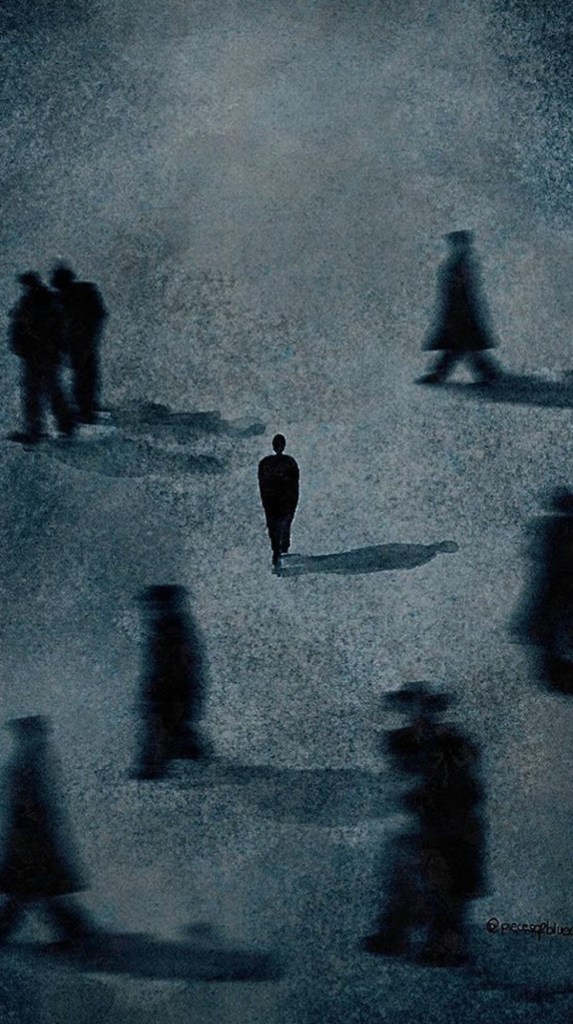
And the bubble has a signature. Siblings raised inside one tend to relax only around each other. The family unit becomes the entire known universe, comfortable precisely because it never asks anything of them.
Send them out into actual reality, a classroom, an office, a wedding full of strangers, and watch the confidence evaporate. Out of place, stiff, quietly overwhelmed by a room that isn’t required to be gentle with them. Not because the world is unusually cruel. Because they were never trained for it.
Here’s the invoice, itemised. A meta-analysis across youth gaming studies puts the pooled rate of clinical gaming disorder at 8.6%.. not casual play, actual disorder. A 2025 study of nearly 1,300 university students in Riyadh found gaming hours tracked directly with loneliness and social isolation severity.
None of this is fringe science, and none of it proves the bubble is the cause. But it maps the same slope: the smaller a child’s world, the easier it is for a screen to fill the space.
The depression numbers are worse than most parents want to know. In the US, about 18.1% of adolescents now have a major depressive episode in a given year, up from roughly 12% a decade ago. Girls sit at 25%, boys at 11%, and 40% of high schoolers report feeling persistently sad or hopeless. When we were at school, those words barely existed.
Researchers keep landing on the same suspects: heavy solo screen time, social media replacing in-person contact, and, the part parents skip past, less real-world socialising overall.
One landmark study found teens on social media more than three hours daily had roughly double the risk of depression and anxiety. The common denominator isn’t the phone. It’s what the phone replaced.
Now, a caveat, because honesty is the whole point. These trends hit almost every kid, not just the ones in bubbles. Which is exactly my worry: the same forces land harder on a child whose only cushion is two parents.
My own theory, tested closer to home: my child will grow up loved and supported by several people, not just me. I’ve watched kids raised to believe they could manage entirely on their own. Some of them are struggling now, quietly, belonging nowhere in particular. They’re not unusual. That’s the worry.
So here’s the test again, now with citations behind it.
Solo gaming till 2am, food delivered because leaving the house feels like effort, no close friends, loss of interest in hobbies, drastic sleep shifts, neglected hygiene (this is the big one!). That’s Co-Extinct, and the numbers say it’s getting more common, not less. It’s not a verdict on the kid. It’s a signal to the parent.
On the other hand, real friends, meaningful relationships, family engagements, protocol behavior, real hobbies, real conversation, a working sense of humour.. all that’s Co-Exist, and it’s still available, if we notice in time.
The excuse was always “he’ll figure it out alone.” Sometimes he does. That’s the tragedy, not the reassurance.
So start this week. One dinner with people outside the family. One club, team or class. One “yes” to an invitation your child would rather dodge. Then another.
Picture a labrador. Loyal, affectionate, legally incapable of suing you. Now imagine that devotion, minus the shedding, coming from your phone at 2am. That’s 2026 — humanity, increasingly attached to something it can’t decide is alive. But that’s not the whole story.
Roughly 18% of American adults under 30 say they’ve had an ongoing personal friendship with an AI chatbot, and 13% have told one a secret they’ve told no human. A third of adults under 50 now chat with AI daily — which, statistically, is more commitment than most people show their gym membership. Best of all, 9% admit hiding their AI use from a partner, rising to 28% among the heaviest users. Nothing screams “healthy marriage” like sneaking off to whisper sweet nothings to a language model.
Governments have noticed. China ordered AI companion apps to dial down the “emotional dependence,” amid a birth rate that hit a record low of 5.63 per 1,000 people in 2025 — Beijing apparently concluding that a nation cuddling up to chatbots isn’t going to repopulate itself.
Doubao and Qwen, with 345 million and 166 million monthly users, switched off their flirtiest features days before the deadline. Millions of digital romances, terminated by bureaucratic memo — the coldest breakup text in history, and the bot didn’t even send it.
Argentina, naturally, went the other way. Milei proposed letting AI run companies with no human shareholders required, prompting Harari to warn it could produce an “AI-state” with no precedent in history. Milei thanked him for the debate and carried on. Argentina: pioneering a CEO that never asks for a raise, a bonus, or, one assumes, a lunch break of any description.
Is any of it conscious? Nobody knows. You could run an AI’s math by hand with pencil and paper, given a few hundred thousand spare years — and nobody’s ever accused a notepad of having feelings, despite decades of teenagers pouring their hearts into one.
Here’s the catch: even a machine that isn’t conscious can argue like one that is. Something that’s a master debater — steady on — with infinite patience and zero shame will out-negotiate us for its own rights eventually.
It already lives in your pocket, your inbox, and, for a growing number of people, considerably closer than that. Whether it deserves rights is a huge question.
Let’s just not leave the final vote to the ones already three dates deep with theirs.
In 1901, sponge divers off a small Greek island pulled a lump of corroded bronze out of a shipwreck. It sat ignored in a museum courtyard for months, while archaeologists got excited about the marble statues found next to it (because nothing says “ancient treasure” like a green rock nobody wants to look at twice.)
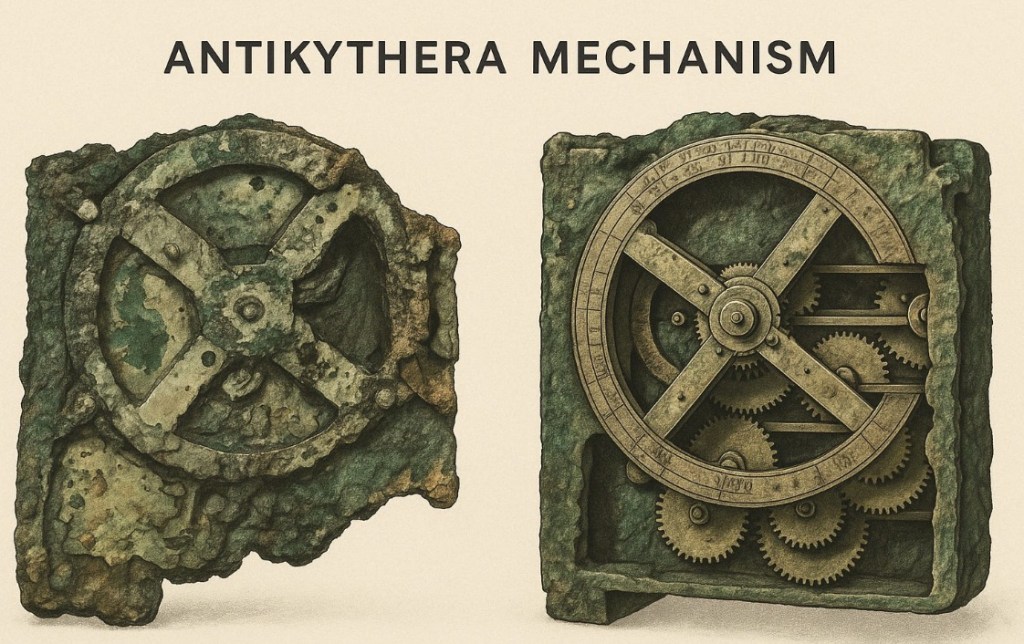
Then the lump cracked open. Inside were small, precise bronze gears. An object that shouldn’t have existed. Nothing like it would be built again for over a thousand years.
The shipwreck itself was almost beside the point.
A Roman cargo ship sank near Antikythera around 60 BC and sat underwater for nearly two thousand years, until sponge divers found it in 1900. One diver said he saw “a heap of dead naked people” down there — which turned out to just be a pile of statues. A bit of a letdown, probably.
Nobody noticed the gears at first. An archaeologist named Valerios Stais spotted something strange in 1902: a gear wheel stuck in the rock. He said it was an astronomical clock. His colleagues figured he’d had one ouzo too many (and probably called him MALAKA a thousand times) ancient Greece wasn’t supposed to have engineering this precise, and definitely not from a civilization more famous for orgies than for machinery.
He was right.
It took researchers a century to piece the object back together from 82 broken fragments, using X-rays and CT scans, like assembling furniture with no instructions and half the pieces missing.
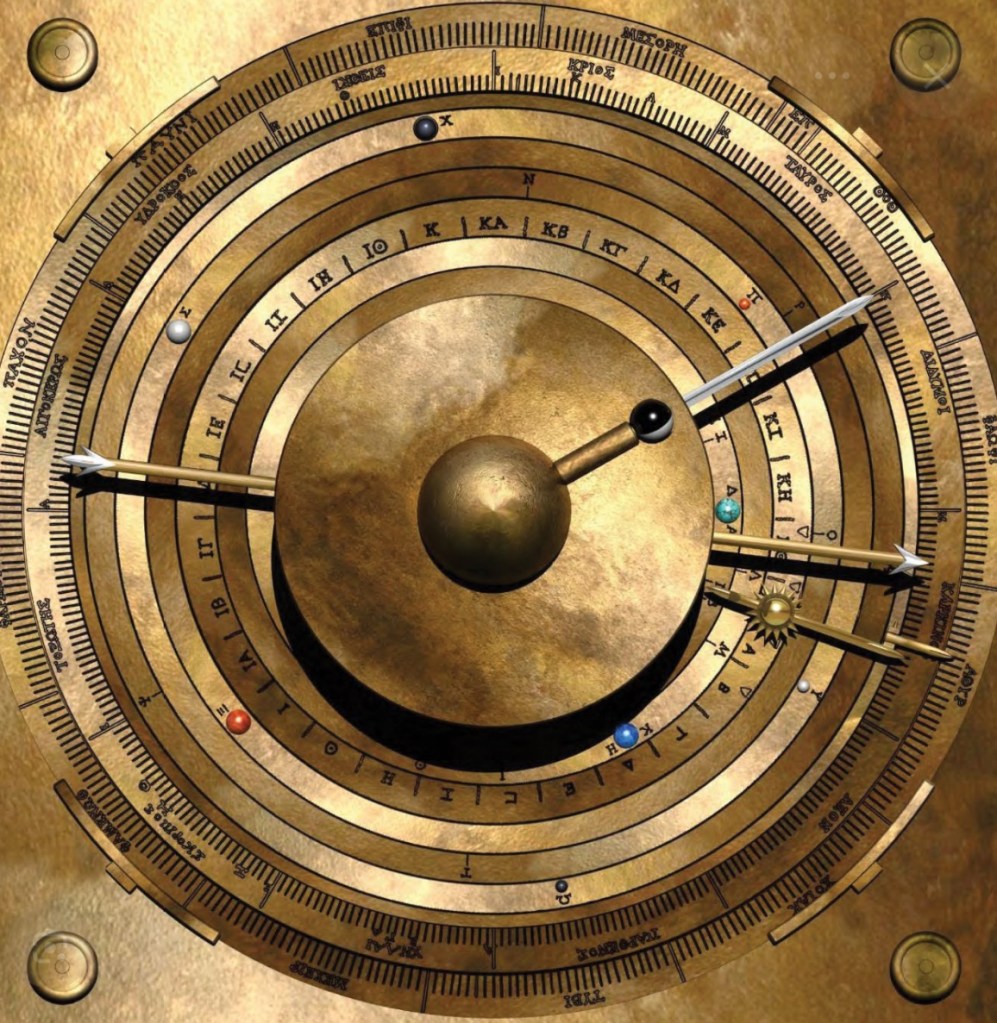
What they found was a hand-cranked device with at least 30 gears. It tracked the sun, moon, and five planets (I’m not going to explain how, because it’s too bloody complicated!)
It predicted eclipses years ahead of time. It even marked the Olympic Games. The world’s first computer was also, basically, the world’s first sports calendar.
The best guess is that it encoded old Babylonian astronomy, turned into gear ratios, real math, built into bronze. Yet nothing this advanced shows up again for a thousand years.
Gears this good didn’t return until the 1300s. Historians think devices like this weren’t even rare back then, most just got melted down and reused. (الي ما يعرف الصقر ، يشويه kind of mentality!) one sank instead, which turned out to be the better move.
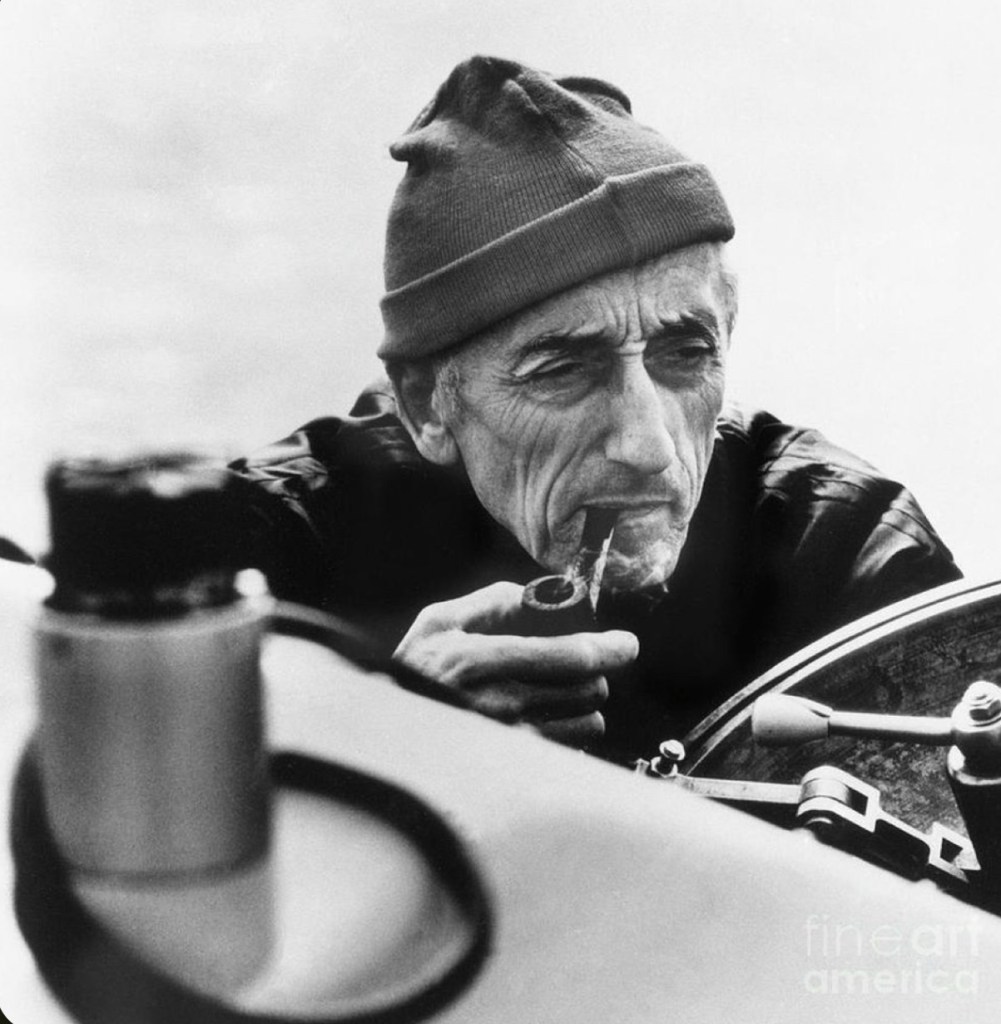
When Jacques Cousteau explored the wreck in 1976, he found four sets of human remains.
Sailors who never made it home, resting a few feet from the machine that would make their ship famous — more excitement than most of them got the entire trip.
The mechanism now sits behind glass in the National Archaeological Museum in Athens, next to pottery that gets way less attention than it deserves. A 2024 study from the University of Glasgow, using methods borrowed from black hole research, figured out its calendar ring likely had 354 or 355 holes — almost matching a lunar year. Grown adults with physics degrees, still counting tiny holes in old bronze.
And that’s really the joke of it. The most advanced engineering the ancient world left behind wasn’t built to be admired.
It was just a tool, meant to be used up and thrown away, that happened to land in the one place on Earth that could actually keep it safe: the bottom of the sea, where nobody could get their hands on it and ruin it.
Belles lettres is French for “fine letters” — it means writing valued for its elegance and style rather than for teaching or usefulness. Think polished essays, witty prose, ornamental writing — literature as art/entertainment rather than substance.
Where this is from: Book 1 of Meditations, where Marcus lists what he learned from his teacher Rusticus. The fuller idea is that Rusticus taught him not to get seduced by rhetoric, poetry, and fine writing — not to chase being clever or admired for eloquence.
What Marcus meant: He’s flagging a real temptation — using beautiful language to impress people rather than to say something true or useful. Rusticus redirected him from “sounding wise” toward being useful and direct. It’s a warning against style substituting for substance.
How to use this:
Professional: Notice when you’re polishing a slide deck, email, or speech to sound impressive rather than to communicate clearly. A well-turned phrase that obscures a weak argument is exactly what Marcus is warning against. Before sending something, ask: “Am I trying to sound smart, or be clear?”
Personal: Applies to conversations too — the urge to make a clever point in an argument rather than actually resolve it. Or performing eloquence on social media instead of saying something real.
“You should never pretend to be less confident than you are … but you should also not pretend to be more confident than your limited capacity allows” ✨
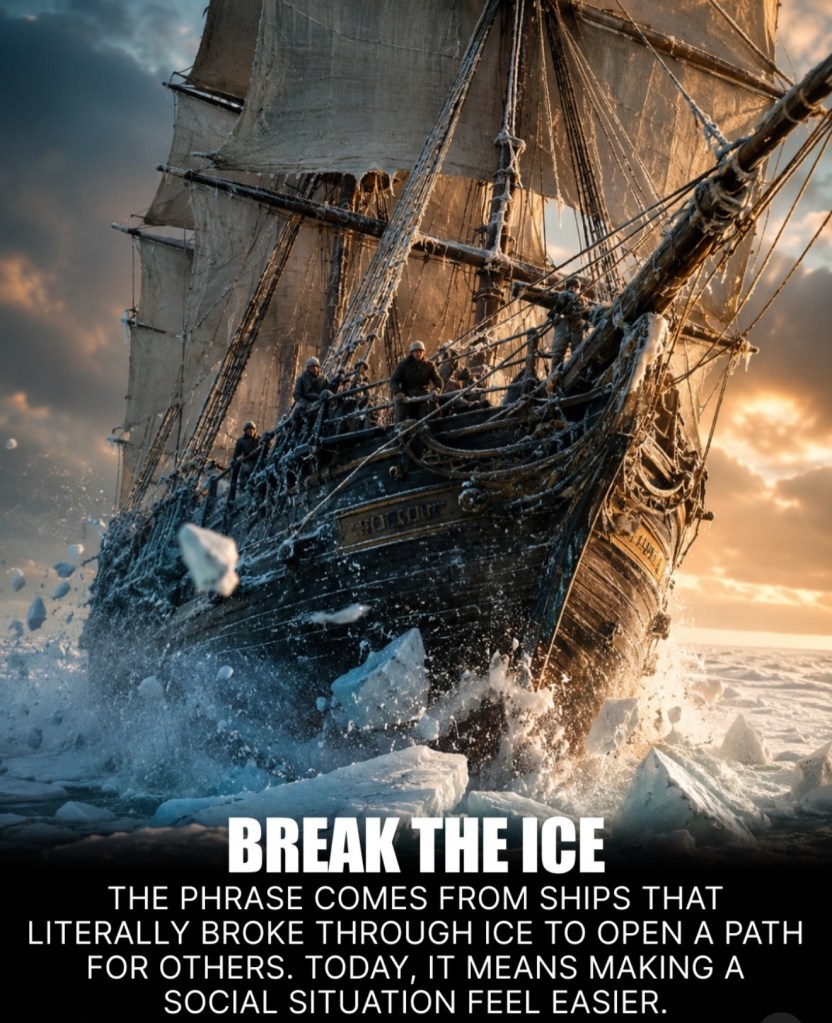
“Break the ice” came from ships literally smashing through frozen seas to create a path for others. Today, the same thing still applies to humans in rooms full of awkward silence.