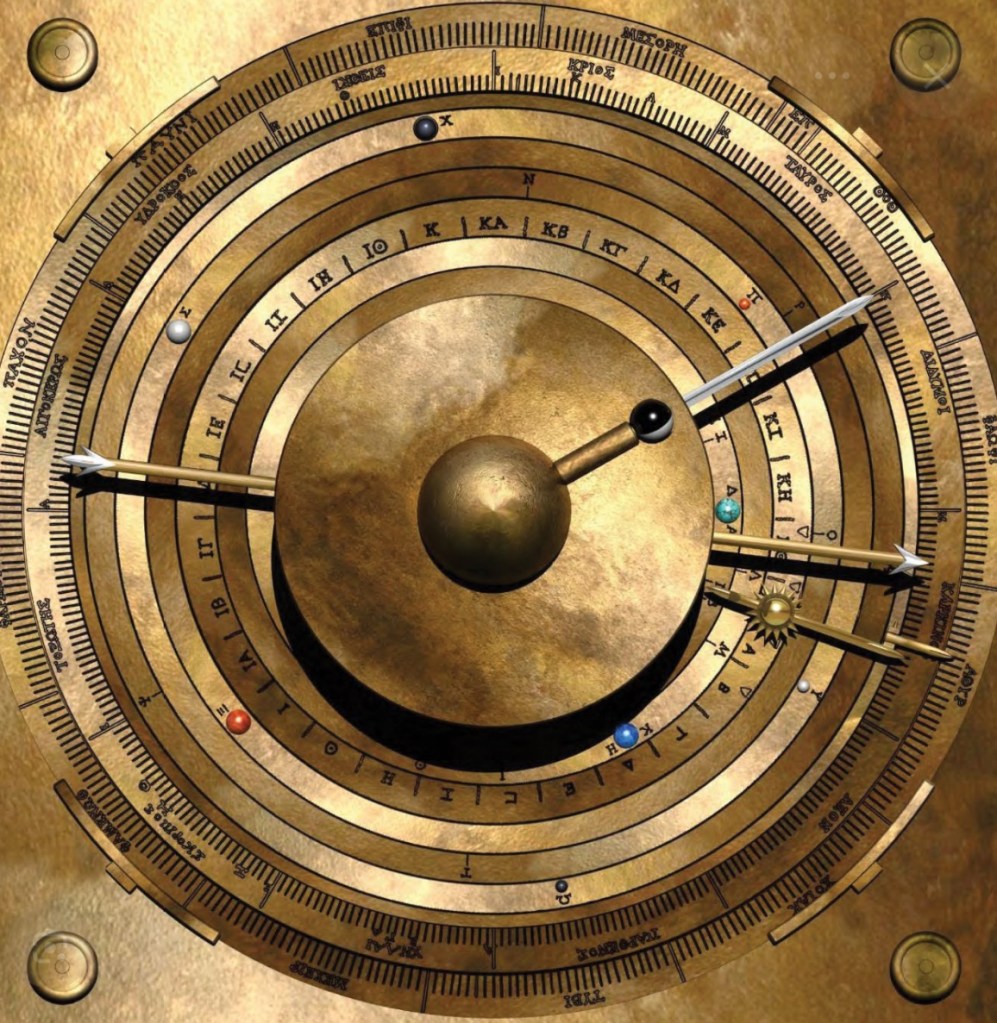
In 1901, sponge divers off a small Greek island pulled a lump of corroded bronze out of a shipwreck. It sat ignored in a museum courtyard for months, while archaeologists got excited about the marble statues found next to it (because nothing says “ancient treasure” like a green rock nobody wants to look at twice.)
Then the lump cracked open. Inside were small, precise bronze gears. An object that shouldn’t have existed. Nothing like it would be built again for over a thousand years.
The shipwreck itself was almost beside the point.
A Roman cargo ship sank near Antikythera around 60 BC and sat underwater for nearly two thousand years, until sponge divers found it in 1900. One diver said he saw “a heap of dead naked people” down there — which turned out to just be a pile of statues. A bit of a letdown, probably.
Nobody noticed the gears at first. An archaeologist named Valerios Stais spotted something strange in 1902: a gear wheel stuck in the rock. He said it was an astronomical clock. His colleagues figured he’d had one ouzo too many (and probably called him MALAKA a thousand times) ancient Greece wasn’t supposed to have engineering this precise, and definitely not from a civilization more famous for orgies than for machinery.
He was right.
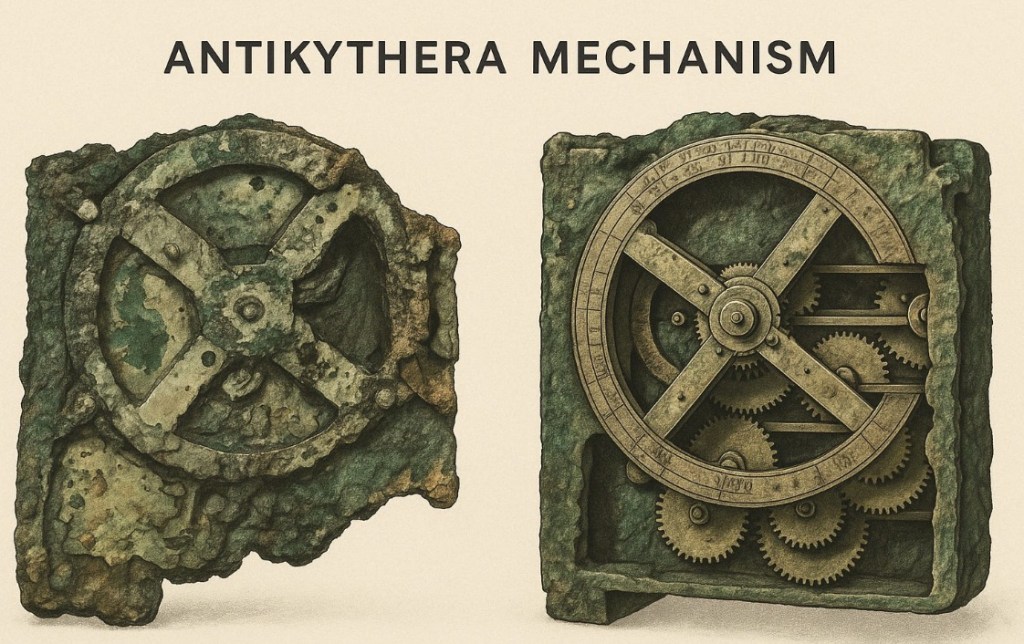
It took researchers a century to piece the object back together from 82 broken fragments, using X-rays and CT scans, like assembling furniture with no instructions and half the pieces missing.
What they found was a hand-cranked device with at least 30 gears. It tracked the sun, moon, and five planets (I’m not going to explain how, because it’s too bloody complicated!)
It predicted eclipses years ahead of time. It even marked the Olympic Games. The world’s first computer was also, basically, the world’s first sports calendar.
The best guess is that it encoded old Babylonian astronomy, turned into gear ratios, real math, built into bronze. Yet nothing this advanced shows up again for a thousand years.
Gears this good didn’t return until the 1300s. Historians think devices like this weren’t even rare back then, most just got melted down and reused. (الي ما يعرف الصقر ، يشويه kind of mentality!) one sank instead, which turned out to be the better move.

When Jacques Cousteau explored the wreck in 1976, he found four sets of human remains.
Sailors who never made it home, resting a few feet from the machine that would make their ship famous — more excitement than most of them got the entire trip.
The mechanism now sits behind glass in the National Archaeological Museum in Athens, next to pottery that gets way less attention than it deserves. A 2024 study from the University of Glasgow, using methods borrowed from black hole research, figured out its calendar ring likely had 354 or 355 holes — almost matching a lunar year. Grown adults with physics degrees, still counting tiny holes in old bronze.
And that’s really the joke of it. The most advanced engineering the ancient world left behind wasn’t built to be admired.
It was just a tool, meant to be used up and thrown away, that happened to land in the one place on Earth that could actually keep it safe: the bottom of the sea, where nobody could get their hands on it and ruin it.
 Simply K
Leave a comment