
The warmth of the sun in winter ✨
The warmth of the sun in winter ✨
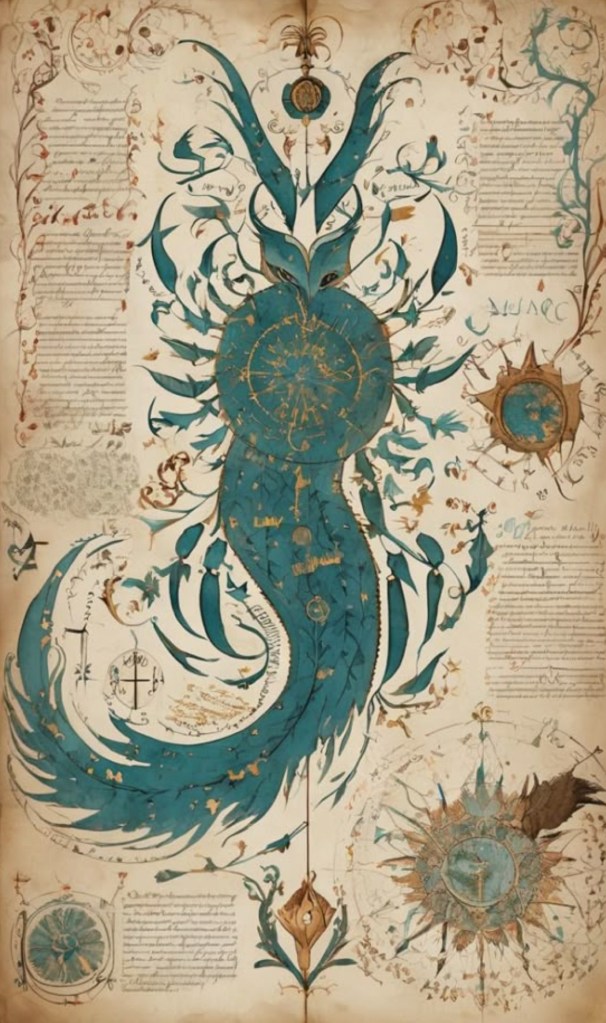
Somewhere in Yale’s Beinecke Library sits a book that doesn’t want to be understood. About 240 pages of carefully drawn plants that don’t exist, zodiac wheels that don’t match the stars, and women—always women—soaking in strange green pools and climbing through pipes like characters in a medieval fever dream.. Its script? Not Latin, not Greek, not Arabic. No known alphabet at all. This is the Voynich Manuscript, and it’s been laughing at humanity since the 15th century.
Carbon dating says the vellum came from the early 1400s, which rules out modern hoaxers. And yet nobody—not World War codebreakers, not CIA cryptographers, not modern AI—has cracked its writing. It has grammar, rhythm, structure. It looks like a language. But it belongs to no tongue we’ve ever spoken.
What Ifs That Refuse to Die
What if it’s a medical guide from a lost civilization, its remedies now forever out of reach? What if it’s an alchemical recipe book, the secret to transmutation sitting in plain sight, locked away by symbols only initiates could read? What if it’s deliberately unreadable, a prank by some medieval trickster who invented a fake language to toy with the future? What if it’s alien, a field guide left behind by visitors cataloguing plants and rituals from a world that wasn’t theirs? What if it was never meant for us at all—what if we are simply the wrong readers?
The Naked Women
They’re the most unsettling detail. Not drawn with erotic flourish, not with religious reverence, just floating, bathing, and climbing through strange vessels as though participating in some ritual or experiment.. Fertility rites? Medical diagrams? Or something far stranger: beings caught in the middle of knowledge we cannot name.
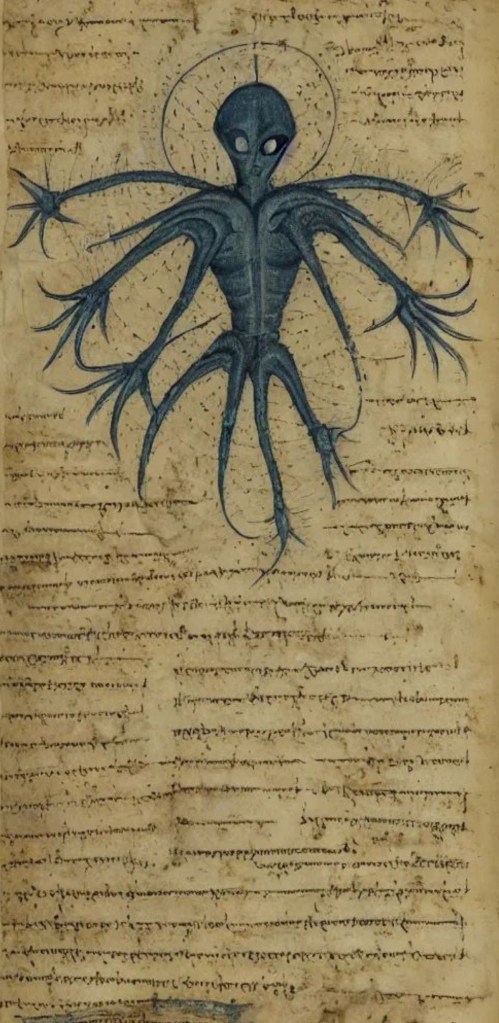
Why It Still Haunts Us
If it were nonsense, our best cryptographers would have dismissed it centuries ago. But it isn’t nonsense—the structure is too tight, the rules too consistent. It feels like language, like meaning, but meaning held just out of reach.
And so the manuscript waits, locked in its glass case, its pages turning only for researchers doomed to join the list of failures.
Final Whisper
What if the book was never meant to be solved? What if its power lies in the torment of mystery itself—in keeping us looking, guessing, forever unsatisfied? What if the Voynich Manuscript is less a book, and more a mirror, reflecting our endless hunger for answers we may never deserve?
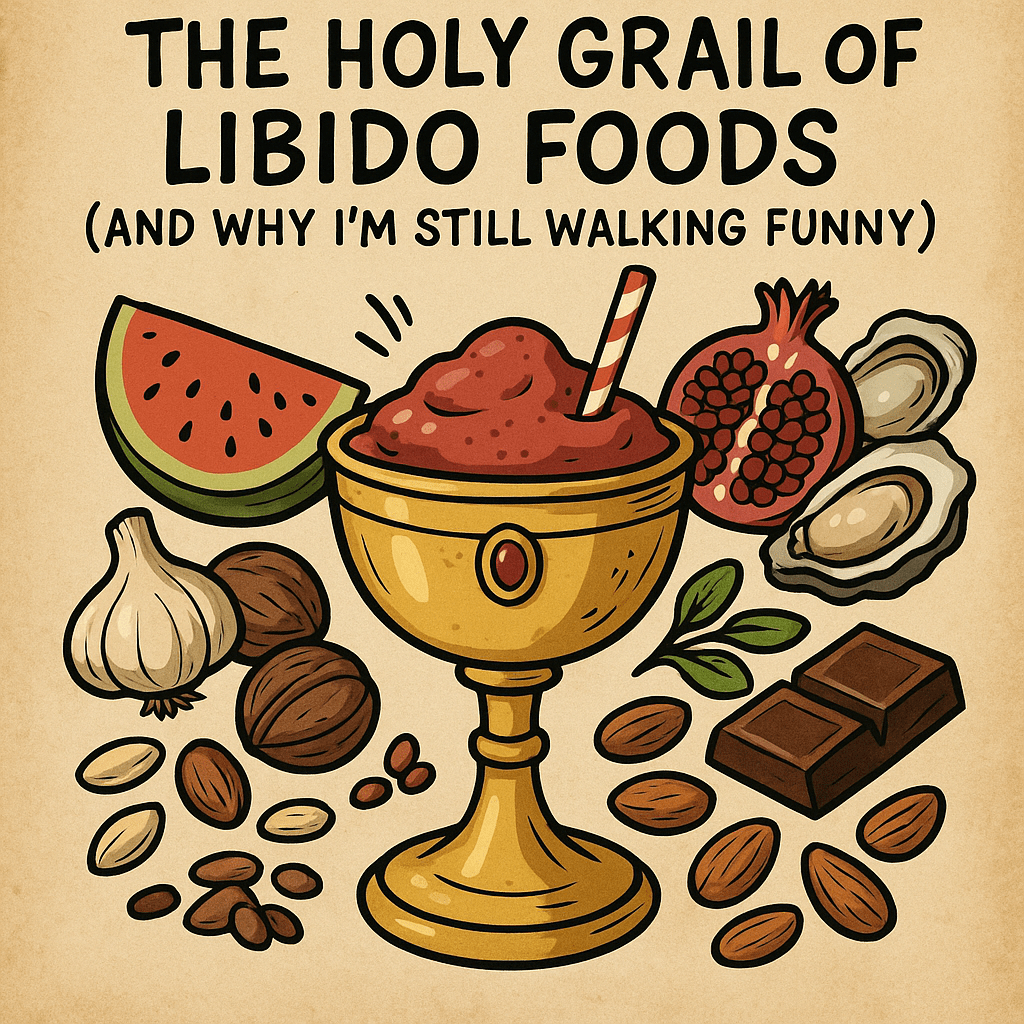
After years of trial, error, and a few awkward trips to the pharmacy, whilst in Athens, I stumbled on what can only be described as the Holy Grail of libido food mixes. Forget overpriced pills with names that sound like rejected Transformer characters—this is real food, real chemistry, and it works.
It started innocently enough. A bit of watermelon here, some pomegranate there. “Good for the heart,” they said. Turns out, it’s even better for other organs… the ones that don’t do much thinking but can certainly change your weekend plans.
Then came the walnuts and almonds—because nothing screams masculinity like standing in the kitchen grinding nuts into a blender. Add a handful of pumpkin seeds and down a pill of zinc, which your body uses to make testosterone and Voilá… Think of it as topping up your ammunition reserves.
For flavour (and plausible deniability when guests ask about the mess in the blender), I threw in dark chocolate and a scoop of maca root powder—the Peruvian powder that somehow manages to make your trousers tighter in all the wrong places. Sprinkle in a bit of fenugreek and garlic, and suddenly you’re mixing something that could resurrect a monastery.
The result? A smoothie that doesn’t just boost libido—it recalibrates your entire operating system. More drive, more volume, more “how are you still going?” looks from across the bed. Drink it daily and, within weeks, you’ll start to feel like you’ve hijacked a Greek god’s Tinder profile.
So there it is: my discovery, my grail, my unsolicited public service announcement. The blend that proves science, sin, and smoothies can coexist. Drink responsibly—or irresponsibly, depending on your weekend plans. 🙂

Forget the French vineyards and Italian grape stomps—wine’s true origin story starts in China. Around 7000 BC, in the Neolithic Yangshao culture of Henan, someone left a clay jar of rice, honey, and hawthorn berries lying about. Wild yeast gate-crashed, got drunk on sugar, and—ta-da—the world’s first booze was born. Archaeologists found the residue, which is basically the ancient equivalent of sticky bar floors.
By the Shang Dynasty (1600–1046 BC), wine wasn’t just accidental; it was official state business.. Bronze vats bigger than hot tubs were dug up—used to serve alcohol to ancestors & guests. Imagine inviting your dead grandma to dinner and thinking, “better bring another keg.”
Then came the Zhou Dynasty (1046–256 BC), where wine was woven into rituals, politics, and excessive feasting. Chinese texts even complained that court officials were hammered on the job. Congratulations, ancient China—you invented both wine and HR problems..
By the Han Dynasty (206 BC–220 AD), things really leveled up. Thanks to the Silk Road, grapevines & winemaking techniques made their way in from Central Asia. Suddenly China had grape wine alongside their fruit-and-rice brews. It was globalization before globalization.
And Europe? They showed up late to the party. The earliest solid evidence of winemaking in the Caucasus region (modern Georgia) dates back to 6000 BC, but wine didn’t really strut into the Mediterranean spotlight until much later—thanks to those same Silk Road and trade routes. By around 2000–1000 BC, grape wine had made its way west, where the Greeks elevated it to a god (literally, Dionysus), and the Romans industrialized it with vineyards, barrels, and binge-drinking festivals that make Oktoberfest look tame.
So the truth is this: China discovered the recipe, Central Asia spread the grape gospel, and Europe turned it into a cultural identity. From ancestor offerings to Roman orgies, all because some Neolithic villager didn’t throw out spoiled rice juice.
Next time someone swirls a Bordeaux and mutters about “terroir,” remind them that wine is 9,000 years of humans refusing to pour out dodgy leftovers.

Not Every Friend is a “Friend”…

Not every friend is a friend. And family will sometimes stick the knife in with better aim. Still, once you’ve had your fair share of treachery, you realize it’s one of life’s lessons, teaching you how to refine your guest list. Consider it natural selection on your inner circle
Grade 9, English Literature. While the rest of the class was busy pretending to love Macbeth (they were all terrified of our Lit teacher), I was locked on to the birds outside the window, convinced their chirping was far more enlightening than whatever was happening on the chalkboard. Most teachers ignored me. Rumors floated around that I spent my time daydreaming and probably bribing teachers to pass my exams. But that day, my Literature teacher finally snapped.
In front of the whole co-ed class she yelled: “If you like the birds so much, I can open the window and send you there.”
Naively, I replied: “It’s not the birds… I’m sure I just saw a grey parrot out there. Never seen one before.”
She thought I was mocking her. I wasn’t. But off to the principal’s office I went anyway.
The principal called my mother (god bless her, she always gave them her number instead of dads!) Her response? “It’s okay, Mr. Do what you want — I’ve already washed my hands of him.”
Charming. But to be fair, she’d already given up on me in Grade 8. That was when she discovered I had skipped every single math class at my old school because I had “forgotten”—very deliberately—to do my homework. I’d been caned twice before, but by the third strike I was finished. I told my brother Ahmed, and let’s just say my math teacher ended up leaving school in a wheelchair. The school politely asked me to get out the following year. (It cost my dad a hefty bribe to let me stay until finals were over.)
The irony? I actually loved English Literature. Macbeth was my jam, and I scored an A. Meanwhile, Physics and Math were complete disasters. My logic was simple: I wasn’t going to be an astronaut, so why bother with Physics? And Math was fine until the alphabets decided to marry the numbers and spawn the cursed offspring known as Algebra. From that point on, I failed those two subjects with flying colors every single year..
The truth is, I didn’t know ADHD was a thing. Neither did Mum. Neither did anyone. They all assumed I was just a spoiled brat who couldn’t be bothered with certain subjects. Yet I could easily pull As and Bs in history, psychology, biology, economics, and, of course, PE.
PE was sacred. I once even showed up to play in a football match against another school—while I was technically on a sick day. PE always landed in the last two sessions of school on Tuesdays. Naturally, the teachers came to watch that particular game, since it was a school championship. That small little detail, my brain had conveniently ignored. Busted.
Looking back, that was the moment I realized I wasn’t built to be “normal.” And honestly, normal never looked all that interesting anyway.
I aim for 10k steps a day. Usually land somewhere between ‘Olympic champion’ and ‘I only walked to the fridge twice
Because my brain doesn’t shut up, and scribbling in WhatsApp notes felt like tossing thoughts into a junk drawer.
This blog isn’t for fame, likes, or some guru nonsense. It’s a digital diary—part rant, part reflection, part “what was I even thinking?” archive.
If you’re reading this, you’re either me in ten years laughing at myself, or you’re lost on the internet and somehow ended up here. Either way, welcome.
Welcome to WordPress! This is your first post. Edit or delete it to take the first step in your blogging journey.


 Simply K