Open a flight-tracking app like Flightradar24 and start exploring airports around the world.
At first glance, all runways look identical: long strips of asphalt stretching across flat land, with mysterious labels like 12L, 30R, or 09L.
To most people they all look the same.
But in reality, runway design reflects a fascinating mix of aircraft physics, weather conditions, airport traffic, and geography. What seems like a simple strip of pavement is actually one of the most carefully engineered parts of aviation.
Let’s start with the basics.
The Secret Behind Runway Numbers
Every runway is named based on its magnetic compass direction.
For example:
Runway 12 means the aircraft is heading roughly 120° The opposite direction becomes 30 (300°)
Since airplanes can take off and land in both directions, the same runway always has two numbers.
When airports have multiple parallel runways, letters are added:
L = Left R = Right C = Center
So a runway labeled 12L / 30R simply means it’s the left runway when approaching from one direction, and the right runway when approaching from the other.
This system is standardized worldwide by the International Civil Aviation Organization.
Comparing Some Major International Airports
Let’s look at several global hubs and their runway sizes.
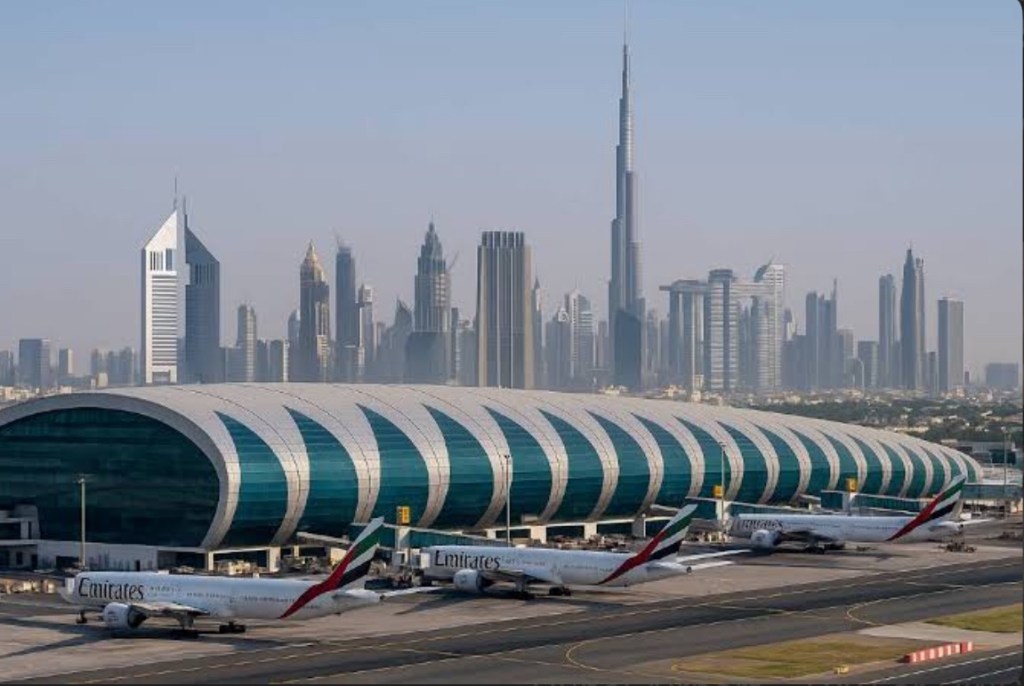
Dubai International Airport
Dubai operates with two parallel runways.
Runway lengths:
4,351 m (14,275 ft) 4,447 m (14,590 ft)
Dubai built very long runways to support heavy long-haul aircraft such as the Airbus A380.
Hot weather reduces engine performance, so aircraft require longer takeoff distances.
Abu Dhabi Zayed International Airport
Abu Dhabi also operates two runways.
Runway lengths:
4,100 m 4,106 m
Slightly shorter than Dubai’s, but still more than capable of handling the largest commercial aircraft.
Hamad International Airport
Doha features one of the longest runways in the world.
Runway lengths:
4,850 m (15,912 ft) 4,250 m
Qatar had plenty of space when designing the airport, so engineers built extremely long runways capable of handling fully loaded long-haul aircraft even in extreme heat.
London Heathrow Airport
Heathrow is one of the busiest airports in the world, yet it only has two runways.
Runway lengths:
3,901 m 3,658 m
These runways are shorter because Heathrow was built in the 1940s, long before modern widebody aircraft existed.
Urban development around the airport now makes expansion extremely difficult.
Why Runway Length Matters
Large aircraft such as the Boeing 777-300ER can weigh over 350 tons at takeoff.
Heavier aircraft require:
longer acceleration distance more lift more runway
Hot weather, high altitude, and heavy payloads all increase the runway length required for safe takeoff.
That’s why airports in hot climates tend to build longer runways.
How Many Runways Do Airports Have?
The number of runways at an airport usually reflects traffic volume.
Airports With 1 Runway
Smaller airports often only need one runway.
Examples:
London City Airport Ibiza Airport Mykonos Airport Paro International Airport Skiathos Airport
These airports handle relatively modest traffic levels.
Airports With 2 Runways
Two runways are the most common configuration for major airports.
Examples:
Dubai International Airport Hamad International Airport Abu Dhabi Zayed International Airport London Heathrow Airport Hong Kong International Airport
Two parallel runways allow aircraft to take off and land simultaneously, dramatically increasing airport capacity.
Airports With 3 Runways
Some large international airports operate three runways to handle heavy traffic.
Examples:
Singapore Changi Airport Tokyo Haneda Airport Beijing Capital International Airport Istanbul Airport Bangkok Suvarnabhumi Airport
These airports support extremely high traffic volumes.
Airports With 4 Runways
The world’s biggest aviation hubs operate four runways or more.
Examples:
Frankfurt Airport Paris Charles de Gaulle Airport Los Angeles International Airport Shanghai Pudong International Airport Dallas Fort Worth International Airport
These airports can handle over 100 aircraft movements per hour.
The Hidden Complexity of Runways
To passengers, runways may look identical.
But to pilots, airport planners, and air traffic controllers they represent a delicate balance of:
aircraft performance weather conditions safety separation traffic flow geographic constraints
A runway may appear simple — just a strip of asphalt — but it is one of the most important pieces of infrastructure in global aviation.
Without them, the entire system of international travel simply wouldn’t work.
 Simply K
Leave a comment