
Everyone knows the pharaohs. Gold masks, pyramids so massive they make your mortgage feel like pocket change, eyeliner sharper than the dagger in Caesars back and curses strong enough to make Joe Pesci sweat. But here’s the embarrassing truth: ask most people who the first pharaoh was, and you’ll get blank stares or a mumbled “Tutankhamun?” (Wrong by about 1,500 years).
The OG pharaoh was Narmer (aka Menes if you’re into ancient pseudonyms). Around 3100 BCE, he wasn’t just some desert warlord — he was the man who turned a messy sandbox of tribes into the idea of Egypt. He basically invented the brand before branding existed.
Where Did This Guy Come From?
Narmer came from Upper Egypt, the southern stretch of the Nile where the sun bakes ambition into people. His home base was probably Thinis, near Abydos, a city that specialized in producing men with egos bigger than their spears.
At the time, Egypt was two kingdoms constantly beefing like Arsenal and Chelsea fans:
Upper Egypt (South): desert fighters, hard and lean.
Lower Egypt (North): lush Nile Delta farmers, fertile land, easy living, fewer swords.
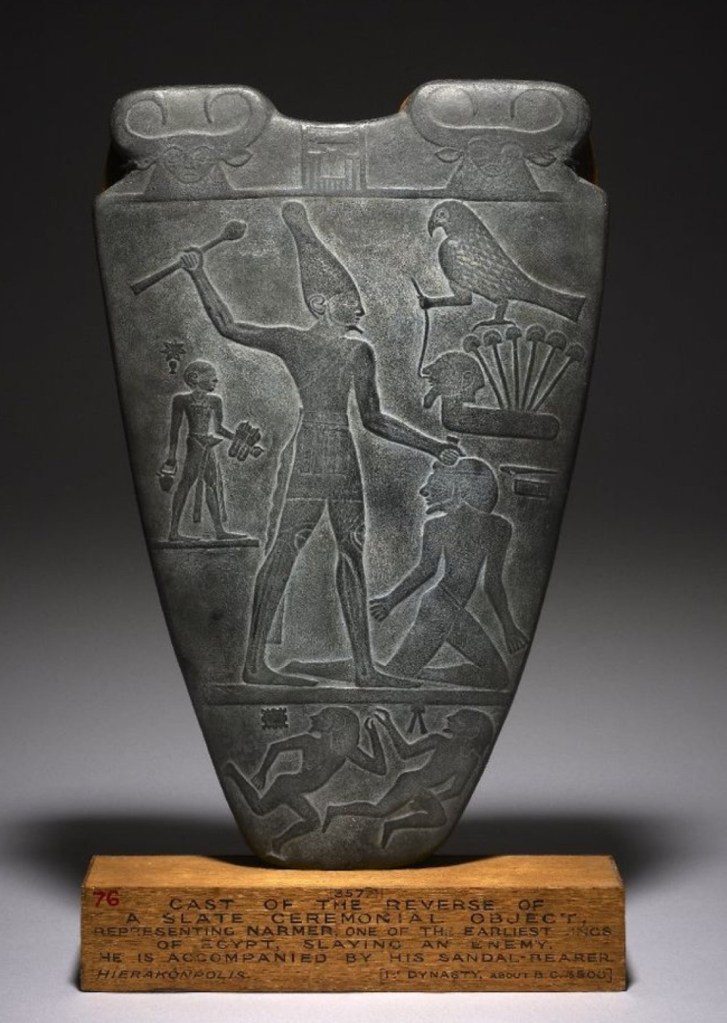
Narmer marched north, smashed skulls, and crowned himself ruler of both. The Narmer Palette — a carved stone slab — shows him literally braining an enemy. That was his press release.
How Did He Pull It Off?
1. Violence. Forget diplomacy — he solved problems with blunt force.
2. Religion. Claimed Horus the falcon god had endorsed him. You can’t really argue when someone says, “God told me I’m in charge.”
3. Propaganda. Wore both crowns, staged rituals, carved his wins into stone. Ancient PR at its finest.
4. Infrastructure. Once unified, Egypt scaled up irrigation, farming, taxation, and trade. Bread, beer, and bureaucracy became the backbone of life (YES, they had beer — thick, porridge-like barley brews made through fermentation. Bread and beer weren’t luxuries; they were breakfast, lunch, and wages. Pyramid workers got 2–4 liters of beer a day as pay. Civilization was built slightly drunk).
What Even Is a Pharaoh?
The word comes from per-aa, meaning “Great House.” First it meant the palace, then the man in it. Pharaohs weren’t just kings — they were gods in human cosplay. Imagine your local politician claiming he’s half-falcon, half-sunbeam, and everyone applauding for three thousand years. That was the gig.
Why Did Narmer Matter?
Because he turned chaos into order. Under him:
• The Nile’s floods fed one kingdom instead of two rivals.
• Trade stretched into Nubia, the Levant, maybe Mesopotamia.
• Religion and writing got standardized.
• Monument-building became the national sport.
Without Narmer, no pyramids, no Cleopatra, no local guides convincing you the Sphinx winks at night from a secret angle for 20 USD..
The Dark Side
Narmer wasn’t noble. He erased rival dynasties, monopolized religion and politics, and created a system where obedience to the “divine king” was obedience to cosmic order itself. His enemies weren’t just defeated — they were deleted from history. Think Stalin with better jewelry and an actual god complex.
How Long Ago?
Roughly 5,100 years ago. Cleopatra? She lived closer to us than to Narmer. By the time Rome strutted onto the stage, Narmer was already ancient myth.
The Legacy
Narmer didn’t just unify Egypt — he made it rich, stable, and just tipsy enough to function. Centralized rule meant predictable food, trade wages, and organized labor. He laid the blueprint for 3,000 years of pharaohs: god at the top, peasants at the bottom, everyone else pretending it was destiny.
And if I can channel my favorite physician Dr Gabor Maté: “humans will tolerate almost anything — taxes, war, even forced labor — if they believe it’s sacred. Wrap power in myth, and obedience stops feeling like oppression and starts feeling like devotion”. That’s Narmer’s true genius: not the violence, but the story he sold.
Final thought: Aliens didn’t build the pyramids. Slightly drunk Egyptians did — on bread, beer, and blind faith in a man who called himself divine. And honestly? That’s far more impressive.
 Simply K
Leave a comment